
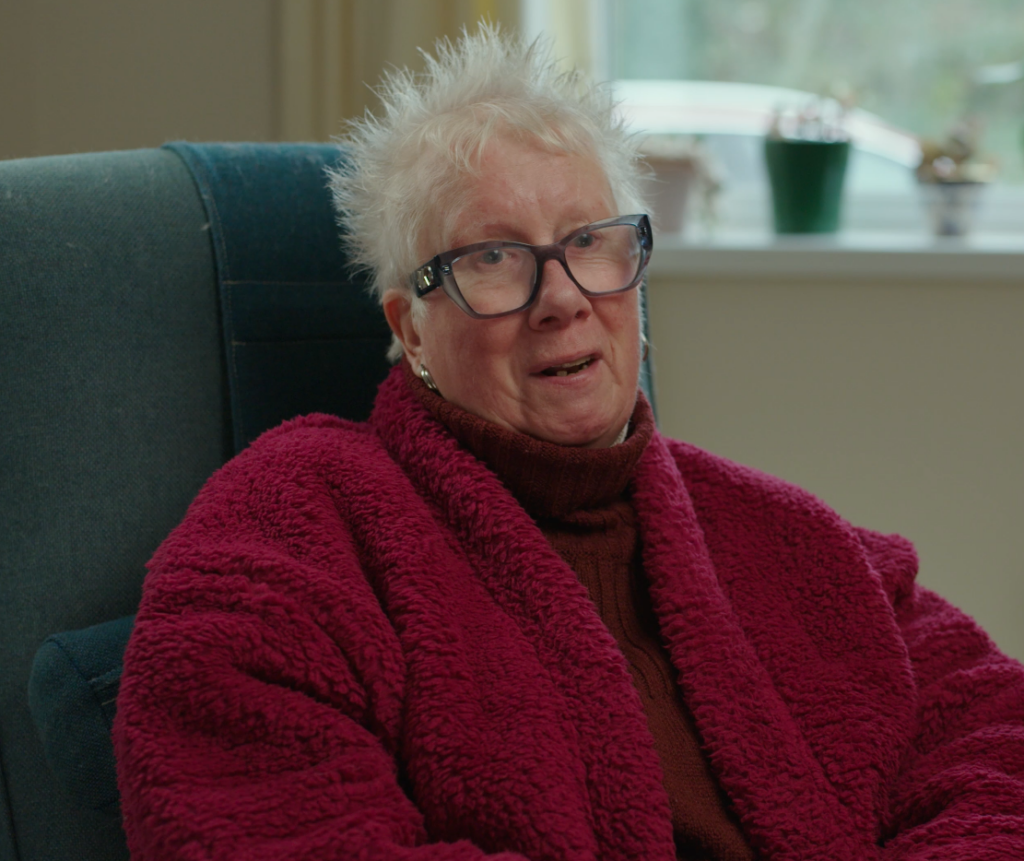
Ann's Story
Bowel Cancer
Ann, in her early seventies and living in a Northamptonshire village, has always been diligent about health checks, including attending NHS cancer screening appointments.
She’d done a routine NHS bowel screening test, known as a FIT test, in November 2021 and had just received a normal result when she attended her first appointment for the NHS-Galleri trial in January 2022. She felt well, had no symptoms, and was enjoying retirement after a career as a property manager and receptionist. “I’d never heard of the NHS-Galleri trial until I got the letter,” she says. “I thought, I’m happy to help researchers investigate a new test—it’ll help somebody else.” In fact, it ended up helping her.
Her Galleri Test Experience
It came as a great shock that her first test detected a cancer signal that was likely to have come from her colon or rectum. “I was numb. I knew I had a rocky road to travel.”
Ann was referred swiftly for a colonoscopy. The procedure confirmed Stage III bowel cancer. “The doctors explained to me that the cancer was Stage III, but they thought that the surgeon would be able to remove it by keyhole surgery. That’s exactly what happened,” she says.
In May, Ann underwent surgery and spent just three days in hospital. Recovery was swift, but chemotherapy proved gruelling. Between June and September, she endured four rounds of treatment plus oral chemotherapy tablets.
Although her treatment was difficult, it was all worth it. Ann’s follow-up scans and blood tests are clear. “I don’t know what symptoms I would have had if the cancer hadn’t been picked up. Without the trial, I dread to think what would have happened. I’d have carried on with life until I felt unwell and gone to the doctor’s. By that time it could have been too late.” she says. “The fact that I’m still here really is the highlight. I hope that blood-based cancer screening becomes more routine.”
“It wasn't Stage IV, which is where it's more advanced and might have spread to other organs."
The Galleri test does not detect a signal for all cancers and not all cancers can be detected in the blood. False-positive and false-negative results do occur. Galleri is a screening test and does not diagnose cancer. Diagnostic testing is needed to confirm cancer. The Galleri test should be used in addition to healthcare provider recommended screening tests.
The overall sensitivity in participants with colon/rectal cancer in a clinical study was 82.0% (43.3% for stage I, 85.0% stage II, 87.9% stage III, 95.3% stage IV).
Important Safety Information
The Galleri test is recommended for use in adults with an elevated risk for cancer, such as those age 50 or older. The test does not detect all cancers and should be used in addition to routine cancer screening tests recommended by a healthcare provider. The Galleri test is intended to detect cancer signals and predict where in the body the cancer signal is located. Use of the test is not recommended in individuals who are pregnant, 21 years old or younger, or undergoing active cancer treatment. Results should be interpreted by a healthcare provider in the context of medical history, clinical signs and symptoms. A test result of No Cancer Signal Detected does not rule out cancer. A test result of Cancer Signal Detected requires confirmatory diagnostic evaluation by medically established procedures (e.g. imaging) to confirm cancer. If cancer is not confirmed with further testing, it could mean that cancer is not present or testing was insufficient to detect cancer, including due to the cancer being located in a different part of the body. False positive (a cancer signal detected when cancer is not present) and false negative (a cancer signal not detected when cancer is present) test results do occur. Rx only.
Laboratory/test information
The GRAIL clinical laboratory is certified under the Clinical Laboratory Improvement Amendments of 1988 (CLIA) and accredited by the College of American Pathologists. The Galleri test was developed—and its performance characteristics were determined—by GRAIL. The Galleri test has not been cleared or approved by the Food and Drug Administration. The GRAIL clinical laboratory is regulated under CLIA to perform high-complexity testing. The Galleri test is intended for clinical purposes.